

Finger Osteoarthritis
Definition


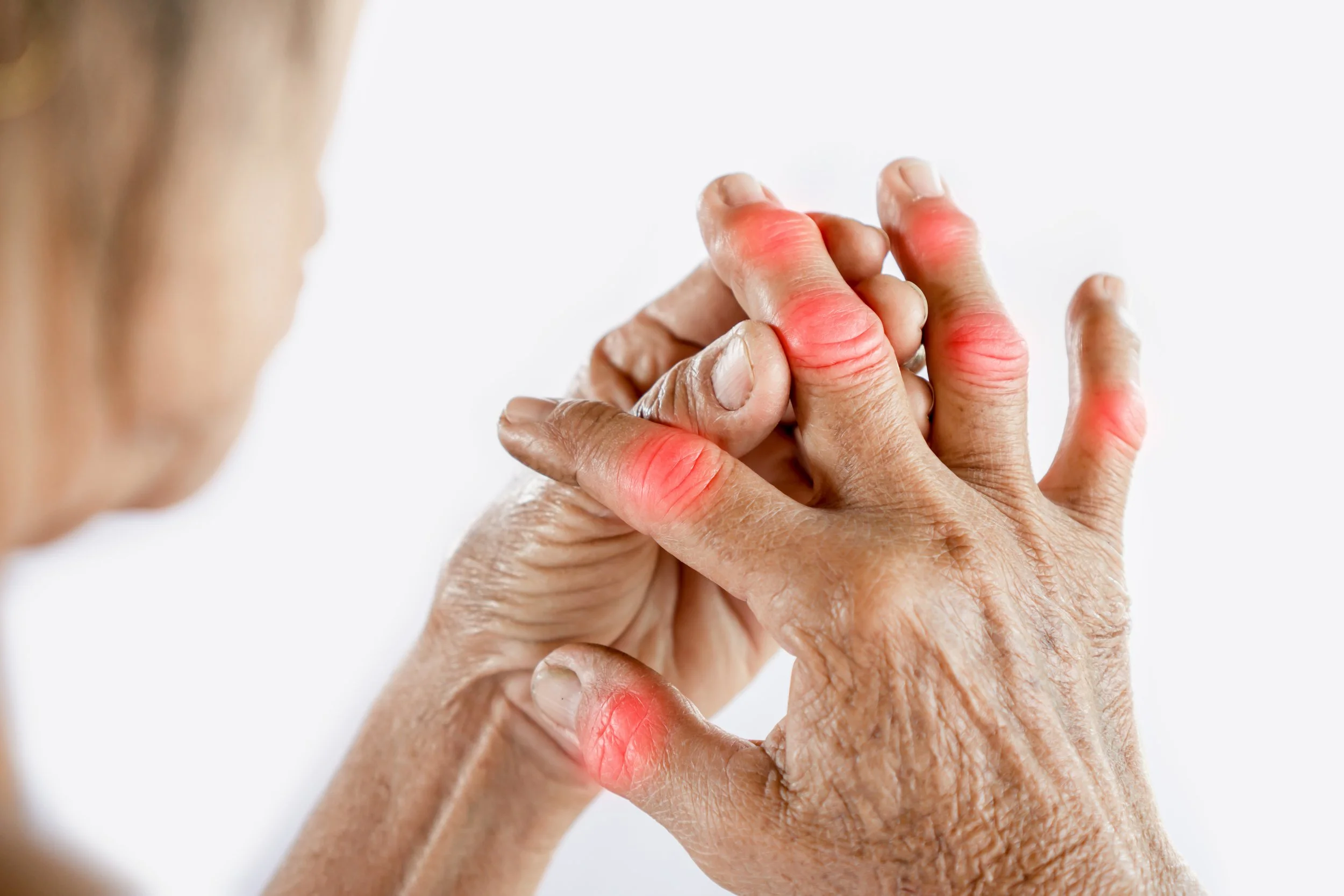
This is a progressive degenerative destruction of the cartilage at the joints of the fingers, which can cause pain and finger deformities that are functionally and/or aesthetically uncomfortable.
What are the causes?
Osteoarthritis appears most often with age and mainly affects women. There may be a family predisposition. It can also be secondary to microtraumas due to chronic finger use, or post-traumatic following articular fractures of the phalanges or joint dislocations.
What are the symptoms?
It manifests as mechanical pain (occurring during activity and during the day), and sometimes inflammatory pain (at rest and at night) during «flare-ups». In advanced stages, deformities and stiffness of the fingers appear, with nodules on the dorsal side of the joints. The discomfort can be both functional and aesthetic.
What tests may be requested?
A standard X-ray assessment of the affected joint(s) will be performed.
How is this condition treated?
Medical treatment will be offered with analgesic medication, rest, custom-made small resting splints, and cortisone infiltrations.
If medical treatment fails or in case of significant aesthetic and/or functional discomfort, surgical treatment may be offered, especially in advanced cases. The procedure varies and depends on the stage of progression, the joint concerned and the patient's wishes. There are two types of treatment:
Conservative treatment:
Debridement and lavage: this is a joint «cleaning» with resection of bony spurs and periarticular nodules.
Denervation (proximal interphalangeal): this involves cutting all peri-articular nerve branches to reduce intra-articular pain; this does not modify finger sensation. The results are variable and may be sufficient to reduce or eliminate pain in cases of mildly evolved osteoarthritis with preserved finger mobility.
Non-conservative treatment:
Joint Prosthesis (metacarpophalangeal and proximal interphalangeal joints of the fingers): a complete replacement of the joint using a silicone prosthesis. The joint remains mobile postoperatively.
Arthrodesis: the definitive blocking of the joint in an aesthetic and functional position (distal interphalangeal joint of the fingers). Metallic material (pins or screws) is used while waiting for bone fusion.
What are the risks of the procedure?
Risks inherent to any surgery:
complex regional pain syndrome (formerly known as «algoneurodystrophic syndrome»): the hand becomes red, warm, swollen, and painful with persistent «electric» pain. This syndrome can last several months.
osteoarticular infection
Recurrence in case of conservative treatment
Loosening / fracture / wear of the prosthesis
Non-consolidation of the arthrodesis – or pseudarthrosis